Butterfly Probe Diagnostics Acceptance: What a Pass Buys
Same symptom on your system?
Tell us your model and what it is doing. A GEPROBE engineer replies with a diagnosis path, part options and pricing — usually within 6 hours, with no obligation.
Chat on WhatsApp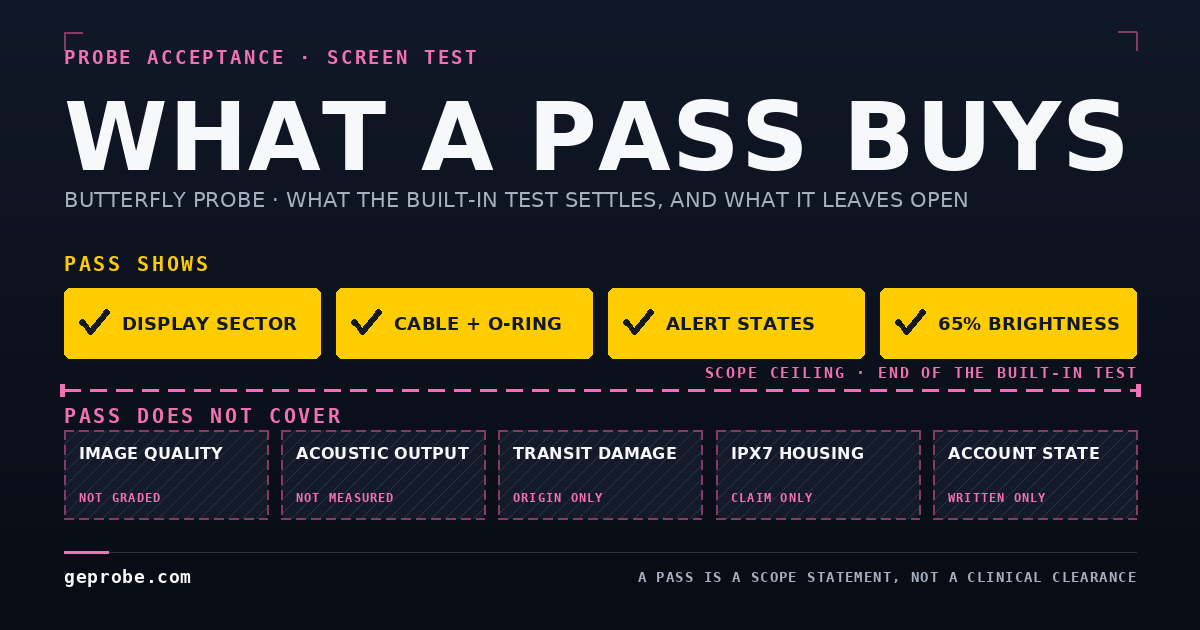
Most butterfly probe diagnostics acceptance files arrive as one screenshot and a story. The screenshot is genuine evidence. It is also narrow: it describes the transducer, and nothing else in the box.
This page walks the rest of the box in buyer order: price, scope, paperwork, display, physical check, arithmetic, record, carriage, and repairability.
The decision on the table is a price, not a verdict
A receiving engineer is seldom asked whether a used handheld is good. The real question is what it is worth while several things remain unchecked.
That reframing does useful work. Treat every unverified line as a discount, not as a disqualification, and the self-test gets a measurable job: it retires exactly one line.
It also kills two expensive habits: paying verified-kit money for a screenshot-only kit, and rejecting a sound kit over a cable that costs less than the courier.
| Kit line | Who can actually clear it | What a pass tells you | If it stays unverified |
|---|---|---|---|
| Sealed probe handle | Manufacturer service only | Element and acoustic check ran, no alert raised | Price at the unknown-condition band, not the verified band |
| Cable and charger | Anyone holding the part number | Nothing | Order the part, re-run the test, keep the receipt |
| Handset and panel | Buyer's IT or QA team | Nothing | Run the ten-minute panel check before payment |
| App and OS floor | Buyer's IT team | Nothing | Re-check the live store listing on receipt, not from a PDF |
| Account, recall and disabled states | Manufacturer support | Only that no alert was showing at that moment | Get written confirmation with the serial number |
| Kit completeness | Receiving technician | Nothing | Itemise against the shipping list, photograph the layout |
| Clinical release | Facility QA, named person | Nothing | Dated signature, or the unit stays in quarantine |
What the manufacturer's own document puts inside the test
Open the iQ3 user manual, revision F, section 16.4, page 82. The user-initiated check is described as exercising the transducer elements, and the app is described as unable to judge the display of the handset it runs on.
Two automatic checks sit beside it in the same chapter. One runs whenever the probe powers up and continues while scanning. The other starts by itself once 25 hours of scanning have accumulated.
Section 16.6, page 85, says scheduled servicing and calibration are not needed to keep the probe working. That is a statement about routine care.
It is not a statement that a four-year-old probe still meets its original acoustic margin. Section 16.7 gives expected life as five years for the probe and three for the cable.
That is a design figure, not a remaining-life certificate for the unit on your bench.
Table 14 in section 17.1 is what most screenshots leave out. It names the states that stop a test rather than fail it.
Those states are: a missing device passcode, a login error, a forced logout, a probe disabled after 30 days without a network connection, a hardware recall, and a thermal cut-out at 43 °C.
Record the revision you read, not the revision you remember
On 26 November 2026 the manufacturer's manual host served seven English revisions of that same iQ3 document — A through G — and none of the seven reported the file as missing.
We read the operating-system floor in revision F, section 19.2, page 90: iOS 17.0 or newer, and Android 12 or newer for the Pixel and Samsung handsets it names.
We did not verify what revisions A to E printed on that page, and that is precisely the problem. So the intake file should carry the revision letter, the page, and the date someone read it.
A compatibility floor copied from a PDF that was current two years ago is a claim you cannot defend in an audit.
The handset is a separate asset, so give the panel its own ten minutes
The phone or tablet is bought on a different order, updated by a different team, and owned by whoever is holding it. Its screen deserves its own verdict rather than a footnote.
- Set the app's brightness to the figure the troubleshooting table recommends, 65%, before judging anything.
- Ask where the defect lives. Inside the image sector it points at the probe or its processing; across menus and status bar it points at the panel.
- Check flat-field uniformity at the four corners, then look for banding across the grey steps of the app interface.
- Count stuck pixels in one fixed area instead of eyeballing the whole screen, so two inspectors can compare notes.
- Press the four UI corners. A digitizer that dies at the edges breaks measurement workflows before it breaks imaging.
- Tilt the screen to roughly 45 degrees. A tint that shifts with angle belongs to the panel, not to the scan.
None of this needs photometric equipment. It produces no release threshold either: display criteria belong to facility QA policy, and no accreditation figure was verified here.
Inspect in an order that keeps the evidence usable
Photograph before you touch. A wipe that removes a scratch also removes the reason for the return.
- Lens face under a torch held at a grazing angle — delamination and surface wear show as a change in reflection.
- Housing seams, and the joint where the cable enters the body.
- Cable jacket over its whole length, flexed gently along the way rather than pressed at one point.
- Strain relief, connector shell, then the pins, with a loupe.
- The O-ring, if the cable has ever been off. Section 16.5 warns that repeated cable swaps wear it and let water and dust in.
- Charging contacts, then the battery indicator lights.
A damaged cable is a part, not a verdict. Table 12 on page 83 lists four cable SKUs by connector type and length, which turns a frayed jacket into a purchase order.
A cracked lens cannot be bought out of the problem the same way.
Turning the unknowns into a number you can write in an offer
The ceiling offer is the verified-working reference price, minus one risk-weighted line for each item you could not verify, minus carriage and insurance.
Write it as: ceiling = reference − (probe risk × probe replacement cost) − (handset risk × handset cost) − (clearance risk × clearance cost) − freight.
Every risk figure is the buyer's own estimate. We publish no failure rates for these devices, because we hold none we could defend.
Worked example, with five invented numbers flagged as assumptions: reference 6,000; sealed-probe replacement 5,200; comparable handset 400; one clearance attempt 250; freight and insurance 180.
Assume 15% probe risk, 30% handset risk, 10% clearance risk. Ceiling = 6,000 − 780 − 120 − 25 − 180 = 4,895.
That is about 18% under verified-kit money, which is the number to carry into the negotiation.
Now remove the panel check because the seller will not allow one before payment. Handset risk is nearer 60% than 30%, the handset line becomes 240, and the ceiling falls to 4,775.
What the intake record has to contain
- Model number read from the label on the probe, not from the sales listing — 850-20026 for the iQ3.
- Manual revision letter, page numbers used, and the date they were read.
- Handset make, model, OS build, app version, and connector type.
- Test state as pass, fail, or not run, with a timestamp and the name of the observer.
- Whether the run was user-initiated or the automatic one, since only the first has a time you chose.
- Panel findings written as observations — "tint at lower left corner, visible over menus" — not adjectives.
- Lens, seam, jacket, strain relief, connector, O-ring and contacts, each with a photo reference.
- Battery indicator level at handover, and how long the unit sat without a charge.
- Accessories present, with part numbers where they exist.
- Disposition — accepted, quarantined, returned — with a named reviewer and a date.
The gap between the pass and your loading dock
Table 17 on page 91 gives operating limits of 0 to 40 °C and brief storage from −20 to 50 °C for up to three days. Brief storage is not a shipping window, and an ocean container is not brief.
The manual asks for a charge at least monthly. A probe that spent a season in a warehouse arrives with a battery question, whatever the screenshot claimed at origin.
IPX7, one metre for thirty minutes, tells you what the housing survives. It says nothing about the panel that travelled beside it or the connector pins that took the shock.
So photograph the packed carton, insure the probe and cable as separate line items, and have the carrier record damage at delivery, not after unpacking.
A test result is not a calibration certificate and should not be declared as one.
The repairability map, and where GEPROBE fits
Once you know which line is weak, ask who can repair it. For a sealed handheld the answer is uncomfortable: the handle goes back to the manufacturer, or it is replaced.
The manual states that the probe is built to stay sealed, that its battery is not user-replaceable, and that replacement by other parties risks heat, fire or explosion.
An independent shop offering to open one is offering something the document forbids.
Our published scope is narrower, and we would rather say so. GEPROBE repair covers endoscope-style TEE, endocavity, 4D volume and standard probes, with a free evaluation and a written failure report.
Our parts supply starts from a confirmed part number. Butterfly is not on our published repair roster.
For a department holding one handheld and twenty cart probes, that split still helps: accessory and cable questions come to us, the sealed handle goes to the manufacturer.
The service manual library is there to document whichever path you take.
Five questions to put to the seller in writing
- What is the serial number, and does the account holding the probe show any recall or disabled state?
- Which manual revision did the seller use, and can the test be re-run in front of you on your own handset?
- Has the cable been swapped, and is the O-ring original?
- How many months has the unit been in storage, and at what temperature range?
- Who is insured during carriage, and will the carrier note condition at delivery?
Sources
- Butterfly iQ3 user manual, revision F — read 2026-11-26; §4.4, §16.4–16.7, §17.1 Table 14, §19.2, Table 17.
- iQ3 manual host, revision G — revisions A–G all returned HTTP 200 on 2026-11-26.
- Butterfly iQ+ product page — replaceable cable, IP67, drop rating; read 2026-11-26.
- Butterfly iQ3 product page — handset pairing model; read 2026-11-26.
- GEPROBE repair services — evaluation and documentation wording; read 2026-11-26.
- GEPROBE about — published brand roster; read 2026-11-26.
Related Articles
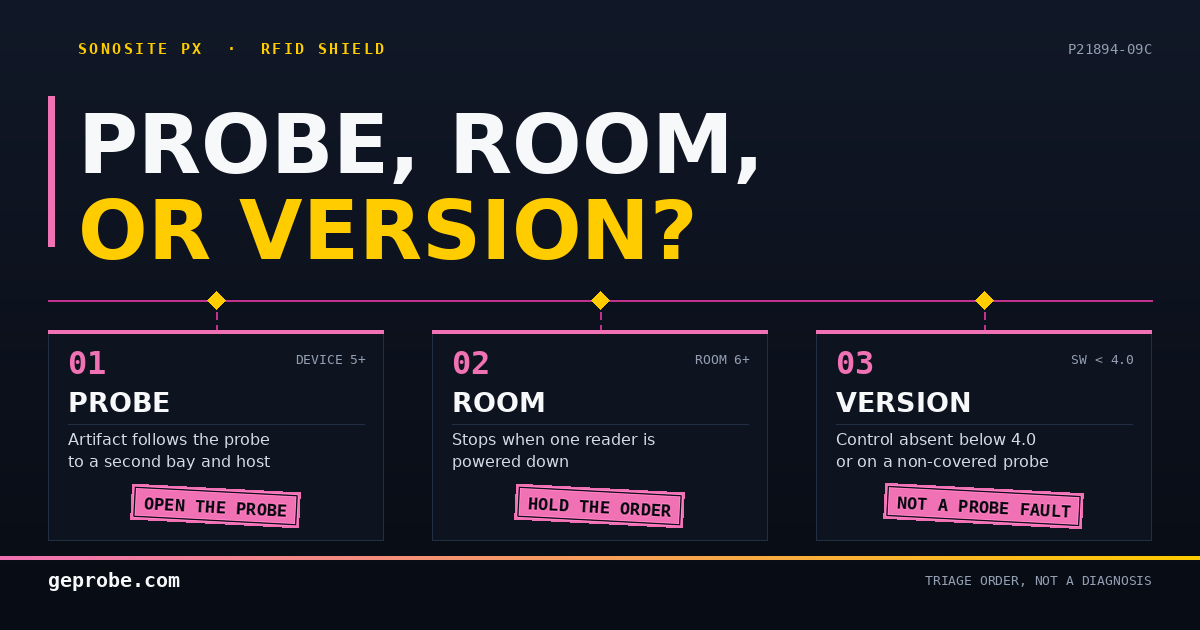
Sonosite PX RFID interference: probe, room, or version?
Before you buy a probe or a board for a Sonosite PX, run the eligibility check and a scored room-versus-device bench matrix. The order that saves parts.
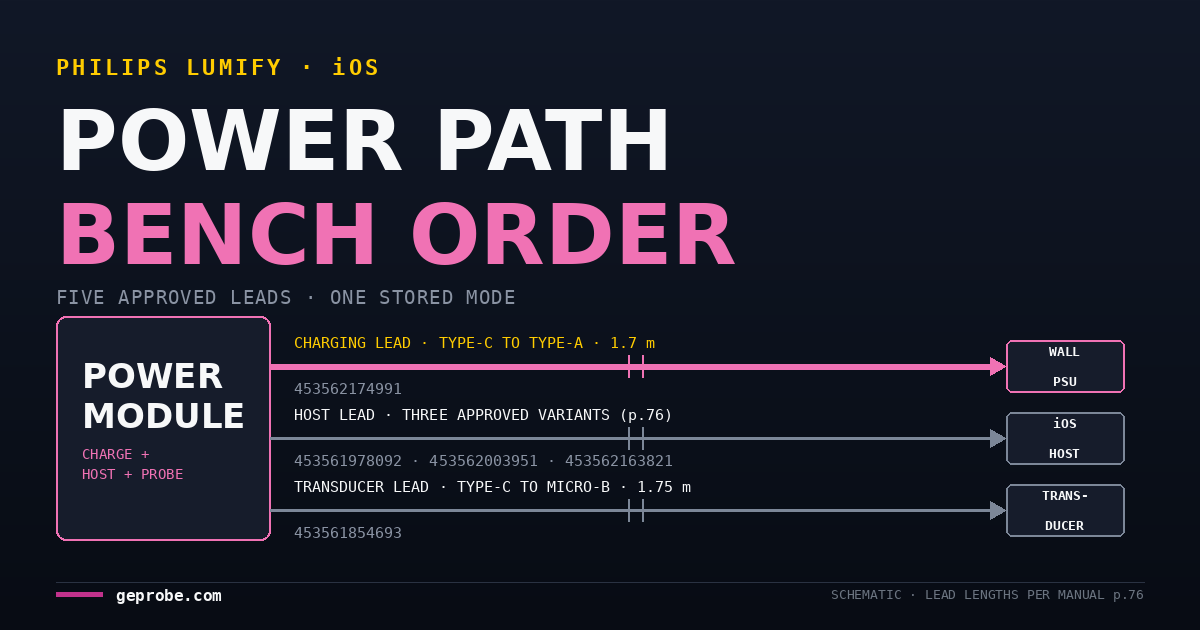
Philips Lumify iOS cable: a bench order of operations
Which leads a Lumify iOS kit needs, how to prove the charging path on the bench, and how to grade a used Power Module before paying.
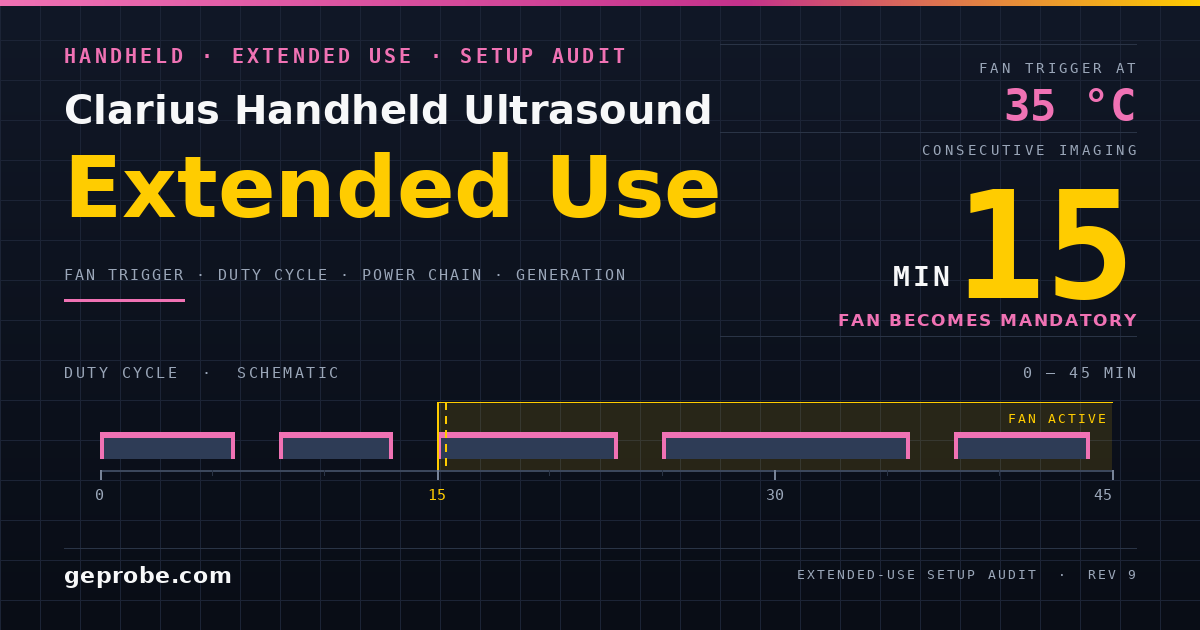
Clarius Handheld Ultrasound Extended Use: A Setup Audit
A fault-domain audit for Clarius handheld ultrasound extended use: measure the fan trigger, size the duty cycle, and verify the power chain.